Pet Travel: New EU Health Certificate From 1 October
By the Pets Locally team
Updated 2026
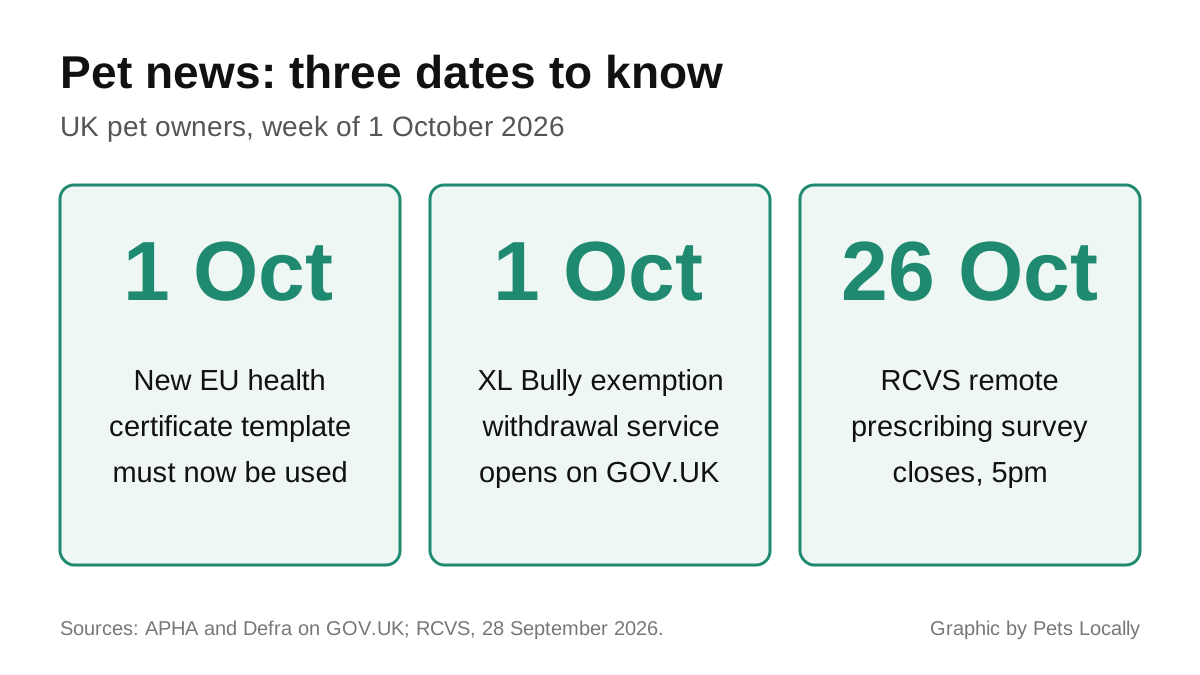
If you are taking a dog or cat to Europe this autumn, the paperwork changed today. Separately, Defra has opened a formal route for XL Bully owners who now think their dog is not an XL Bully, and the vets’ regulator has started reviewing the rules that let a vet prescribe without seeing your pet in person.
Pet travel to the EU: the new health certificate is mandatory from today
The EU changed its pet travel rules on 22 April 2026 and brought in a new animal health certificate (AHC) template. It agreed a transition period so that official vets in Great Britain could keep issuing the old template up to and including 30 September 2026. From 1 October 2026 the new template must be used, according to APHA’s guidance for ferry, rail and airline staff, which was updated today.
For owners, the practical point is simple: if your vet issued your AHC before today on the old form, it is still a valid document, and APHA says both templates will be in circulation for a while. Anything issued from now on should be on the new one. An AHC is only good for entering the EU within 10 days of issue, and you need it every trip, so book the appointment with an official vet early. The rest of the process has not changed: microchip first, a rabies vaccination at least 21 full days before travel, and for dogs heading to Ireland, Finland, Malta or Norway, a tapeworm treatment recorded on the certificate. GOV.UK sets the steps out in Taking your pet dog, cat or ferret abroad, and the carrier guidance is here.
If you are booking kennels or a sitter instead, check the vaccinations your dog needs for boarding now, because kennel cough cover needs time to work too.
Your dog’s tablets can be seized at the border
The Veterinary Medicines Directorate’s list of seizures for September 2026 includes 111 Apo-Frusemide 20mg tablets, a human medicine, that arrived with a dog from Australia and were stopped at the port of entry on the way to a home in Greater London. The reason given is that the medicine is not authorised for use in Great Britain. Frusemide is a common diuretic for dogs with heart disease, so this is the kind of supply an owner might reasonably pack.
If your pet is on long-term medication and you are moving to or returning to the UK, ask a UK vet before you travel what the authorised equivalent is and get a UK prescription lined up. The VMD publishes every seizure on its illegal animal medicines page.
XL Bully owners can now withdraw an exemption certificate
On 1 October Defra published a new service for owners who hold a Certificate of Exemption for an XL Bully and no longer believe their dog is one. It covers certificates issued in England or Wales between 14 November 2023 and 1 February 2024, but not ones issued by a court. You need the dog’s Exempted Dog Index Number, which is on the certificate and in the original email from awddi@defra.gov.uk.
Defra’s warning is blunt. Deciding whether the dog meets the XL Bully conformation standard is the owner’s responsibility, and Defra will not comment on individual dogs. A withdrawn certificate cannot be reinstated or replaced. If a dog turns out to be an XL Bully after the certificate is withdrawn, the owner commits a criminal offence, the dog can be seized, and keeping it means going through the courts. Defra’s advice is that if you are unsure, do not withdraw. The service is on GOV.UK. The separate rule on not leaving a child alone with a banned breed dog still starts on 1 November.
The RCVS is reviewing remote prescribing rules
On Monday 28 September the Royal College of Veterinary Surgeons launched a survey of vets and veterinary nurses on its “under care” guidance. That guidance, introduced in late 2023 and early 2024, sets out when a vet can prescribe prescription-only medicines, including whether they need to have examined the animal in person. It decides what an online or video vet can actually prescribe for your pet.
The survey closes at 5pm on Monday 26 October 2026. The RCVS has also commissioned VetCompass research on clinical records for nearly 8 million animals from before and after the guidance, which it says will be published as part of the review. Nothing changes for owners yet, but this is the process that could loosen or tighten remote prescribing. The announcement is on the RCVS website. For what to look for in a practice now, see our guide to finding a good vet in the UK.
Looking for someone local?
Search your town to find checked groomers, walkers, sitters and pet shops near you, with real owner reviews.
Find local pet services