EU Pet Travel: New Form Lets Someone Else Take Your Pet
By the Pets Locally team
Updated 2026
Three pieces of official pet news from the past week. The government has published the form you need if someone else is taking your dog or cat to the EU, its vets have assessed the risk of a flesh-eating fly arriving with imported pets, and the committee that checks policy for animal welfare has told the housing department it forgot about the dogs of homeless people.
A friend can take your pet to the EU, but only with this declaration
On 7 October the Animal and Plant Health Agency published a dedicated GOV.UK page and downloadable declaration for owners who want someone else to travel to the EU with their pet. Only the owner can fill it in and sign it, and the person travelling with the pet must carry it. The owner’s name has to match the one on the pet’s animal health certificate, and each pet is listed by microchip number and health certificate number, up to five pets on one form. It has to be printed and signed in pen.
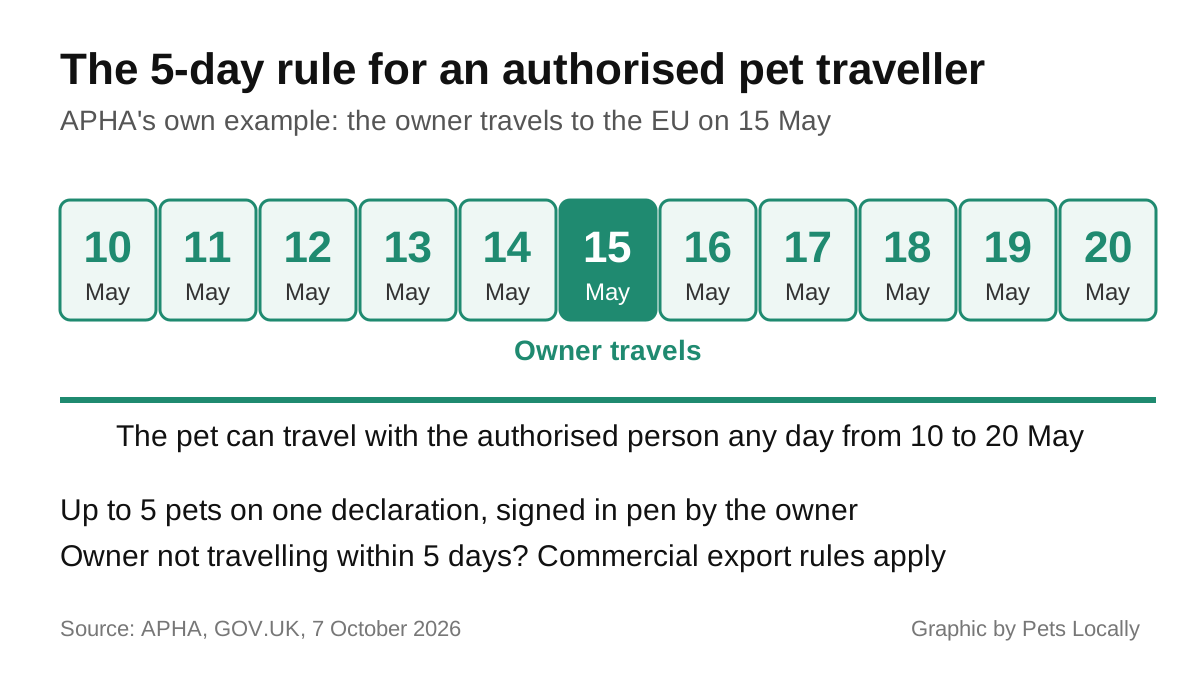
The catch is timing. You, the owner, must travel to the same destination within 5 days of your pet, either before or after. APHA’s example: if you travel on 15 May, your pet can travel any day from 10 May to 20 May. Miss that window and the trip no longer counts as pet travel; it falls under the commercial export rules, which are far stricter. The form also has to be in a language of the country you are going to. There are versions in English only (use this for Ireland), French and English, Spanish and English, and Dutch and English; for any other language you ask APHA.
This fits the change we covered last week, when the new EU animal health certificate became mandatory on 1 October. If the plan is for a relative to drive the dog over while you fly, sort the declaration when you book the official vet appointment, not at the port. If the dog is staying behind instead, our comparison of pet sitting and boarding covers the other option. The forms are on GOV.UK.
Screwworm: the risk from an imported dog or cat is rated negligible
On 6 October Defra published a rapid risk assessment on New World Screwworm, a parasitic blowfly whose larvae feed on the living flesh of mammals and can kill them. It was detected in the USA in June 2026, and by 29 June there had been 27 confirmed cases in domestic animals there, one of them a dog in New Mexico. The assessment looks at whether the fly could reach Great Britain through the legal import of cats, dogs and horses from the USA, Brazil and Argentina.
The answer is reassuring for now. The chance of one imported cat, dog or horse from the USA bringing it in is rated Negligible, and Very Low from Brazil and Argentina, largely because an infested wound is hard to miss at the pre-export vet check. Between 2021 and 2025 an average of 292 cats and 569 dogs a year were imported commercially from the USA. The report adds that if an infested animal did arrive, British weather could let the fly develop to adulthood between April and October, and Defra has no figures for pets travelling with their owners rather than commercially.
For owners, the practical step is the one the assessment assumes you will take: if you bring a dog back from the Americas and it develops a wound or sore that will not heal, see a vet straight away and mention where it has been. Our guide to finding a good vet helps if you are new to an area. The assessment is on GOV.UK.
The national homelessness plan left out pets, says the Animal Sentience Committee
The Animal Sentience Committee, which checks whether government policy has given due regard to animal welfare, published a letter to the housing department on 6 October. Its finding is that “no explicit regard was given to the welfare of animals” in the government’s National Plan to End Homelessness, published in December 2025, and that the plan does not mention companion animals at all. Officials told the committee that animal welfare “was not explicitly considered” because the plan is a high-level strategy.
The committee’s point is a practical one. Many people who are homeless rely on a dog, and where temporary housing or support services cannot take animals, owners face a choice between their dog and a bed, which can end in separation or abandonment. It recommends that guidance for councils and housing providers should cover how to avoid separating people from their animals, and that government works with animal charities and homelessness charities on pet-inclusive accommodation. It is an opinion, not a formal report, so the government does not have to respond to it in Parliament. The letter is on GOV.UK.
Looking for someone local?
Search your town to find checked groomers, walkers, sitters and pet shops near you, with real owner reviews.
Find local pet services