Ring Search Party for Dogs Reaches the UK: How It Works
By the Pets Locally team
Updated 2026
Three things for dog owners from the past fortnight. Ring has brought its lost-dog camera search to the UK, the first bird flu case of the season has been confirmed in England, and the government has said no to a longer ban on bathing and swimming after a spot-on flea treatment.
Ring’s Search Party for Dogs is now available in the UK
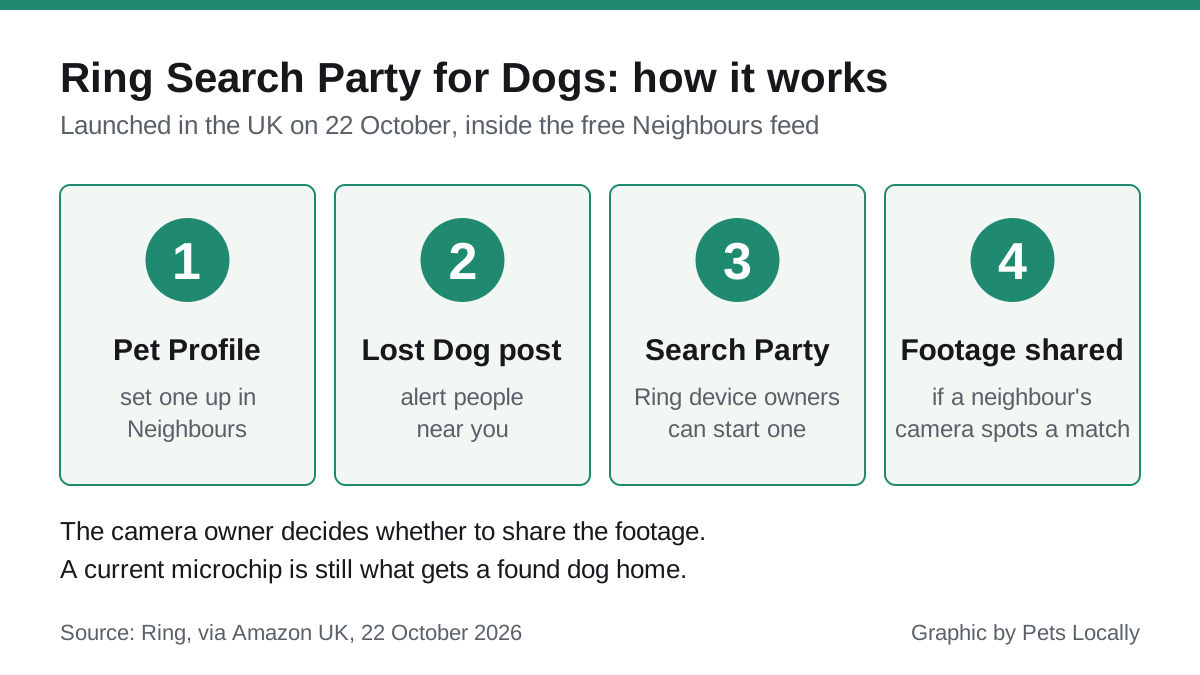
Amazon’s Ring launched Search Party for Dogs in the UK on 22 October. It launched in the US in late 2025, where Ring says it has helped bring home more than one lost dog a day. It sits inside Neighbours, the free community feed in the Ring app, which anyone can use whether or not they own a Ring camera.
It works in four steps. You set up a Pet Profile for your dog in Neighbours. If the dog goes missing, you post a Lost Dog alert to people nearby. If you own a Ring device you can then start a Search Party, and outdoor Ring cameras belonging to neighbours who take part start looking for your dog. When a camera spots a possible match, its owner is told and decides whether to share the footage with you. Ring says the Search Party itself will open to people without an active Ring device “soon”; for now, posting the alert is the part everyone can use. Ring has partnered with Dogs Trust on the launch, and quotes the charity’s Stray Dog Survey: councils took in more than 25,000 stray dogs in a single year, and only around 38% went back to their owners.
A camera search helps, but the microchip is still what gets a found dog home. Every dog in England must be chipped by eight weeks old, and the details only work if they are current, so check your phone number and address with the database after any move. Our dog microchipping law guide explains the rules. If someone else is walking or boarding your dog, give them a recent photo and the chip database’s number before you go away. Source: Amazon UK.
Bird flu: the first case of the season in England
The Animal and Plant Health Agency confirmed highly pathogenic bird flu (H5N1) in commercial poultry near Belford, in north Northumberland, on 19 October, with a 3km protection zone and a 10km surveillance zone around the farm. It is the first case in England of the 2026 to 2027 season, which officially starts on 1 October; Scotland’s first came on 2 October, in backyard poultry on the Isle of Lewis. On 21 October the government put the risk of bird flu in wild birds at medium, and the risk to poultry at low where biosecurity is poor and very low where it is strict. Last season there were 100 cases across the UK.
Cats and dogs can catch bird flu, though the government calls the risk small and notes that garden birds are less likely to carry it than ducks, geese, swans and gulls. Its advice for pet owners is straightforward: keep your dog under control near wild birds, especially where you see warning signs; do not let pets eat, chew or play with dead or sick birds, their droppings or feathers; and do not feed non-commercial raw poultry, game or wild bird meat. If your pet falls ill, tell your vet whether it has been near wild birds or eaten raw meat or treats. If you keep hens, keep the dog and cat out of their area. Sources: GOV.UK latest situation and how to keep pets safe.
No 28-day swimming ban after spot-on flea treatments
The government has turned down a House of Lords committee’s call to extend the period a dog should not bathe or swim after a spot-on parasite treatment from four days to 28. The Environment and Climate Change Committee had found that spot-ons keep contaminating water for up to 28 days after they go on. In its response, published by the committee on 5 October and reported by the veterinary trade press this month, the government said the evidence comes from a small number of animals and is not yet enough to justify a mandatory change. It will keep the current advice and promote its “Be Spot On Aware” campaign instead.
It did accept several of the committee’s other recommendations, including publishing anonymised sales data for pet parasite medicines and better training for those who advise on them. Separately, the Veterinary Medicines Directorate is reviewing how medicines containing fipronil and imidacloprid, two common flea treatment ingredients, can be sold, including online, and says a summary of the responses to its call for evidence is due in late October.
For owners, nothing on the packet changes. Follow the bathing and swimming limits printed on the product, and if your dog has a groomer’s appointment or a beach trip coming up, ask your vet whether a tablet would suit better than a spot-on, and whether your dog needs treating every month at all. Book grooming around the treatment rather than the other way round; how often to groom your dog has the usual intervals by coat type. Source: the government’s response (PDF).
Looking for someone local?
Search your town to find checked groomers, walkers, sitters and pet shops near you, with real owner reviews.
Find local pet services