Complaining About a Vet: 3,600 Cases a Year Go to VCMS
By the Pets Locally team
Updated 2026
Four things for pet owners from the past fortnight. The vets’ regulator has published what its own data says about complaints, a single search across the main microchip databases has gone live, animal charities say the Budget left owners with nothing, and the PDSA has set out how to get a pet through Halloween.
What owners complain about when they complain about a vet
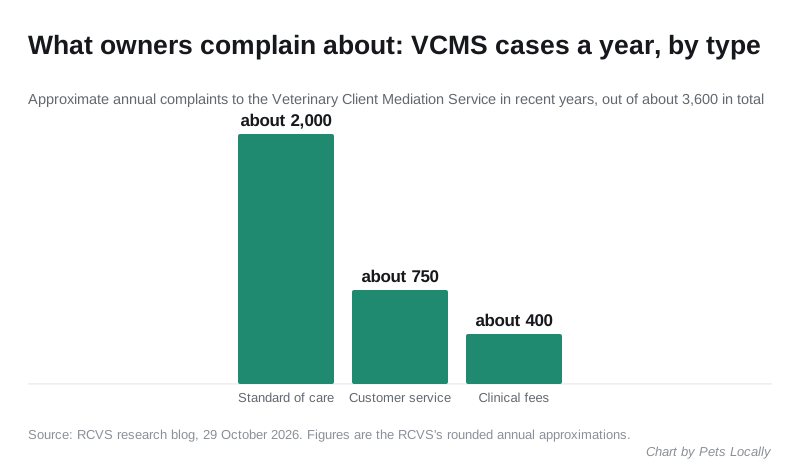
The Royal College of Veterinary Surgeons (RCVS) published an analysis of complaints about vets on 29 October, written by its research manager Vicki Bolton and research officer Eri Tsukamoto. It separates two routes that owners often confuse. The Veterinary Client Mediation Service (VCMS) handles everyday disputes between a practice and its clients, and has received about 3,600 complaints a year recently: roughly 3,600 in 2022 to 2023, 3,500 in 2023 to 2024 and 3,600 in 2024 to 2025. The RCVS’s own concerns process is for serious questions about a vet’s conduct or fitness to practise, and handles far fewer.
“Standard of care” is the biggest category at the VCMS by a distance, more than half of all complaints and around 2,000 a year. Customer service accounts for around 750 and clinical fees for around 400. At the RCVS, concerns rose from around 480 in 2022 to 2023 to 600 and then 700 in 2024 to 2025, which the authors say is worth watching. Few go far: in 2024 around 600 concerns were raised, 36 matters reached the second stage of investigation and 12 vets appeared before the Disciplinary Committee. The RCVS still takes around 3,500 enquiries a year, and points suitable ones to mediation.
If something goes wrong, raise it with the practice first and in writing, with dates, what was agreed and copies of any estimate or invoice. If that does not settle it, the VCMS is the next step for most disputes, including about care and fees; the RCVS route is for misconduct. To head off a dispute over fees, ask for a written estimate before any procedure. How to find a good vet lists the questions to ask before you register. Source: RCVS.
One search now covers five microchip databases
The Association of Microchip Database Operators has launched a Single Point of Search portal, which the British Veterinary Association welcomed on 15 October. There are more than 20 separate microchip databases in the UK and they do not share data, so a vet or warden scanning a found pet has often had to work out which one holds the record. The first phase covers five of them, Chipworks, Identi, MyPet, Petlog and PETtrac, which the operators estimate hold more than 90% of active registrations. Three more databases are in the process of joining.
The portal is for vets, rescues, councils, dog wardens, trading standards and the police, not for owners. It also cannot fix a record that is out of date or a chip that was never registered, as the operators themselves point out. So the job for owners is the same as before: check your phone number and address with your chip’s database, especially after a move. Cats Protection’s latest figures, cited in the coverage, found 23% of cats were not chipped. Our guides to the dog microchipping law and the cat microchipping law explain what you have to do. Sources: BVA and Vet Times.
The Budget had nothing specific for pet owners
The RSPCA and Dogs Trust said on 28 October that the Autumn Budget contained no specific measures to help people struggling with the cost of keeping a pet. The charities had asked for VAT relief on pet food and veterinary care and for funding for community pet food banks. The RSPCA’s Animal Kindness Index found 56% of pet owners are worried about affording vet bills and 18% about paying for pet food, and Dogs Trust says it has had more than 30,000 enquiries this year from owners looking to give up their dog, many because of money.
With no help coming, the best defence is knowing the full cost before it arrives. Our annual dog cost calculator adds up food, insurance, grooming, walking and boarding, and the PDSA and other charities run low-cost vet care for owners on qualifying benefits. Source: London Post, carrying the charities’ joint statement.
Halloween: five steps from the PDSA
The PDSA published its Halloween advice on 23 October. Its 2026 PAW Report found one in four dog owners say their dog barks for more than a minute at a time at someone outside the window, and on Saturday 31 October that someone will be in a costume. Its five steps: keep decorations, carving tools and lit pumpkins out of reach (battery candles are safer); keep chocolate and sweets, and their wrappers, away from pets, because chocolate is poisonous to dogs, cats and rabbits and xylitol in some sweets is extremely dangerous to dogs; skip the pet costume; set up a quiet room away from the front door; and walk the dog before dark, while bringing a cat’s evening meal forward so it comes home early.
If your dog does get into the sweets, ring your vet straight away rather than waiting for symptoms. Our dog chocolate toxicity calculator gives a quick read on how serious an amount is, but it is not a substitute for that call. If you have a sitter booked for the weekend, tell them where the treats are kept. Source: PDSA.
Looking for someone local?
Search your town to find checked groomers, walkers, sitters and pet shops near you, with real owner reviews.
Find local pet services