Questions to Ask Before You Book a Mobile Dog Groomer
By the Pets Locally team
Updated 2026
Dog grooming is not a regulated profession in the UK. There is no specific licence to set up as a groomer, and no legal minimum qualification, so anyone can print a card, fit out a van, and start washing dogs tomorrow. Groomers must still comply with the Animal Welfare Act 2006 at all times, and a breach can carry imprisonment, an unlimited fine, or both, but that is a welfare backstop, not a competence check. The practical result is that the burden of vetting sits with you. A mobile groomer will take your dog into a van on your driveway, often out of your sight, and hand them back an hour later. The questions below are the ones that separate a trained, insured professional from someone who simply owns a hydrobath.
For context on what a fair quote looks like, see our guide to dog grooming prices in the UK, and if you want to estimate your own dog’s session you can use the dog grooming cost calculator.
Why these questions matter more for mobile grooming
A salon has a shopfront, reviews stuck to the window, and other customers in the waiting area. A mobile groomer arrives alone, works one-to-one in a van, and leaves. That setup has real advantages: one dog at a time, cage-free, no kennel wait and no barking pack to wind up a nervous dog, and no exposure to other animals that might be unvaccinated or carrying fleas. It also means less casual oversight, which is exactly why a short list of upfront questions earns its place.
In June 2025 the Canine and Feline Sector Group (CFSG), working with the Pet Industry Federation (PIF) and the British Isles Grooming Association (BIGA), published the first official Best Practice Guidelines for Dog and Cat Groomers. It is the closest thing the trade has to a benchmark. The guidelines recommend groomers hold at least an Ofqual Level 2 qualification, carry out a pre-groom health and behaviour assessment of every animal, clean tools after each use with a daily deep clean, hold professional liability insurance, and never exceed three hours per session unless genuinely necessary. You can use those points as a yardstick for the answers you get.
Qualifications and training
Ask plainly: what qualifications do you hold, and where did you train? Because the trade is unregulated, the words “qualified” and “professional” mean nothing on their own. There are real, verifiable qualifications to check against.
The City and Guilds Level 3 Diploma in Dog Grooming is an Ofqual-regulated qualification that sits in the Regulated Qualifications Framework, and a groomer has to pass the Level 2 Certificate for Dog Grooming Assistants before they can take it. You can look up any regulated qualification on the government’s Ofqual register. The CFSG guidelines set Level 2 as the recommended minimum, so a Level 3 holder is comfortably above the bar.
Two follow-ups are worth asking:
- Do you hold canine first aid training, and can you read dog body language? A groomer who can spot rising stress before it becomes a bite or a panic is safer for your dog.
- Are you a member of an industry body such as the British Dog Groomers’ Association? The BDGA is the specialist grooming division of the Pet Industry Federation; members agree to abide by its code of conduct. Membership also matters for recourse, covered further down.
Insurance: what “insured” should actually mean
“I’m fully insured” is a phrase, not a policy. Ask what cover they hold and what it actually protects.
A proper groomer policy includes public liability, which covers injury to a third party or damage to property where the groomer has been negligent, for example if a dog slips its lead, bolts, and causes a road collision. Specialist insurers in this niche include Cliverton, Protectivity and Pet Business Insurance. As a sense of scale, Cliverton’s groomer policy sets out a multi-million-pound public liability limit, with higher limits available at extra cost, and explains exactly how excesses work. The point is not the number; it is that a real policy spells out limits and exclusions, while “fully insured” on a flyer tells you nothing.
One detail many buyers miss: a groomer who works from home, or stores a van and equipment at home, has to tell their home insurer, and a lot of UK home insurers will not cover a home-based business. It is a fair question to ask whether their business activity is properly declared.
What’s included, and what it costs
Get the price and the inclusions in the same breath, because a low headline figure often means add-ons are billed separately. Ask exactly what a standard groom covers: how many washes, nail clipping, ear cleaning, eye area, anal glands, teeth, and whether a full clip or hand-strip costs more.
Then ask how and when you pay. Some mobile groomers are cash only, others take card; you do not want to discover that on the doorstep.
On price, treat any quote as a current-year range rather than a fixed rate, since breed, coat condition and region all move it. Mobile grooming usually costs a little more than a salon, and a severely matted coat that needs a careful shave-down, or veterinary attention, will cost more again. For typical figures, our dog grooming prices in the UK guide breaks it down by breed and region, and the dog grooming cost calculator gives you a quick estimate for your own dog.
Mobile logistics: how the van actually works
This is where most question lists fall silent, and it is the part that is unique to mobile. Ask:
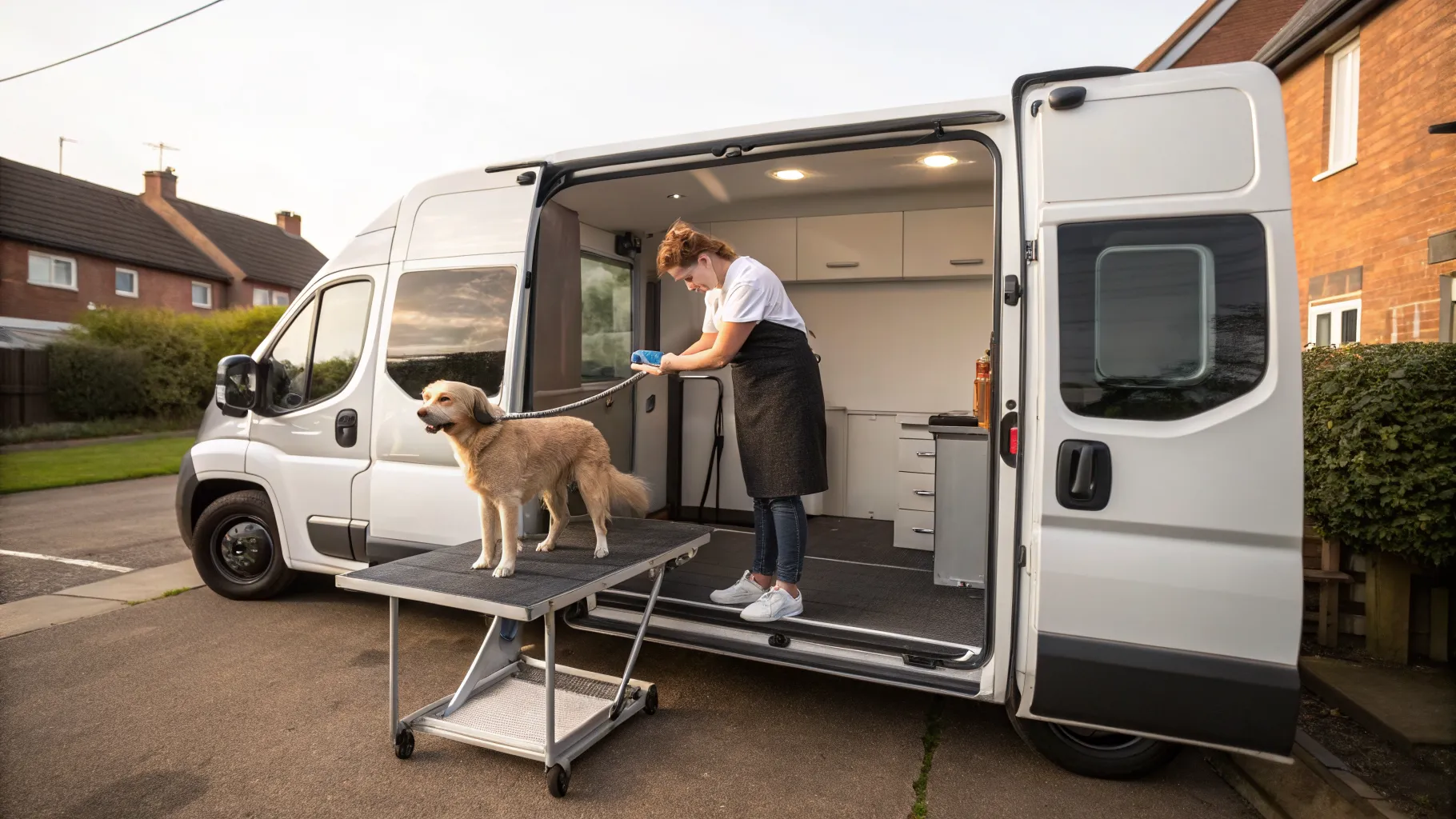
- Do you need to plug into my house, or does the van run independently? Many grooming vans are largely self-contained, carrying a fresh-water tank, a recirculating hydrobath pump, and on-board water heating. Some run entirely off an inverter and battery and need no mains power at all; others need access to a single 13A socket and carry a long extension cable to reach a house or outdoor socket. Any mains connection should be RCD-protected.
- Where will you park? The van needs a flat space it can sit beside, a driveway or a usable stretch of street.
- How long will it take? A typical appointment runs about 60 to 75 minutes, stretching towards two hours for a large or heavily coated dog. Remember the CFSG three-hour ceiling; a session pushing past that without a clear reason is a flag.
The drying question almost nobody asks
Ask directly: do you use a heated cage or cabinet dryer, and is my dog ever left unattended while drying? This single question carries more safety weight than its profile suggests.
Heated cage dryers have been linked to serious harm. STV News reported the case of a puppy that collapsed and later died after being left in a heated cage dryer at a UK groomer; the cause was disputed, but the owner went on to campaign for tighter rules and clear consent before a heated cage is used. The recognised risk climbs with poor air circulation, high humidity, cramped cages, and the bad habit of draping towels over them; flat-faced (brachycephalic) breeds are the most vulnerable. The reassuring part for mobile customers is that the format answers the question for you: a mobile groomer working one dog at a time will usually hand-dry, which sidesteps cage-dryer risk entirely. It is still worth confirming.
Temperament, vaccinations and emergencies
Tell the groomer about your dog before they meet, and ask how they handle nervous, elderly or reactive dogs, and whether they muzzle when needed. A good answer describes patience and reading the dog, not just restraint.
Ask about vaccinations: many UK groomers ask for proof of current vaccinations before they will book, and some request Bordetella (kennel cough) cover too. This is the groomer’s own policy rather than a UK legal requirement, but it is a reasonable one.
Cover the unhappy scenarios while everyone is calm. What is your emergency procedure if my dog is taken ill or injured? Which vet would you go to, and who do you call? Then ask the boring but useful admin questions: what is your cancellation and no-show policy, how much notice do you need, and will you send photos or updates during or after the groom? Photo updates are an easy ask for a mobile groomer and a good sign of an open operator.
The competence test: coats, matting and shaving
How you handle the shaving question tells you a lot, fast. Ask: do you ever shave double-coated breeds, and what is your policy on matted coats?
Double-coated breeds, which include the Golden Retriever, Husky, German Shepherd, Border Collie, Labrador, Springer Spaniel and Chow Chow, should generally not be shaved. The double coat insulates against both cold and heat; shaving it can worsen shedding, raise heatstroke risk, and trigger post-clipping alopecia, where the coat grows back patchy or slowly. The American Kennel Club explains why shaving a double coat is usually the wrong move. The one clear exception is a severely matted or pelted coat, where shaving becomes the humane option to avoid pulling at the skin. A reputable groomer who reaches for the clippers in that case will explain why, rather than shaving any thick coat by default.
The same conversation is a chance to set expectations on frequency. Curly and low-shedding coats such as Poodles, Cockapoos and other doodles need a professional groom every six to eight weeks at minimum, closer to every four to five weeks if home brushing is patchy, with daily brushing in between to keep mats from forming.
If something goes wrong: recourse
Because the trade is unregulated, your recourse depends partly on who the groomer is affiliated with. The Pet Industry Federation runs a dispute-resolution service for clients of BDGA members. That is one more practical reason to ask about industry membership: it gives you somewhere to go beyond a review and a refund argument.
While you are lining up the right people for your dog, the same vetting habits apply to other services. Our guides on how to choose a dog walker and dog boarding vs house sitting walk through the equivalent questions for each.
Frequently asked questions
Is dog grooming a regulated profession in the UK? No. There is no specific licence and no legal minimum qualification to work as a dog groomer in the UK, which is why vetting questions matter. Groomers must still comply with the Animal Welfare Act 2006 at all times, and a breach can be punished with imprisonment, an unlimited fine, or both, but that is a welfare law rather than a competence standard. To check a qualification a groomer claims, look it up on the government’s Ofqual register.
Does a mobile groomer need to use my electricity or water? Often not. Many grooming vans are largely self-contained, with their own fresh-water tank, a recirculating hydrobath and on-board water heating, and some run entirely off an inverter and battery. Others need access to a single 13A socket and carry a long cable to reach one. Most will need a flat parking space the van can sit beside. Always confirm this when you book.
What qualification should a dog groomer have? The CFSG Best Practice Guidelines, published in June 2025, recommend at least an Ofqual Level 2 qualification. The City and Guilds Level 3 Diploma in Dog Grooming is a regulated qualification a step above that, and it requires passing the Level 2 Certificate first. Canine first aid training is a valuable extra.
Why won’t a good groomer shave my double-coated dog? Double coats, on breeds such as Golden Retrievers, Huskies and German Shepherds, insulate against heat as well as cold. Shaving can worsen shedding, increase heatstroke risk, and cause post-clipping alopecia, where the coat regrows patchy or slowly. The exception is a severely matted coat, where shaving is the humane choice. A competent groomer explains the reasoning rather than shaving any thick coat as a default.
How long should a mobile grooming appointment take? A typical session runs about 60 to 75 minutes, and up to roughly two hours for a large or heavily coated dog. The CFSG guidelines say grooming should never exceed three hours per session unless genuinely necessary, so a much longer appointment without a clear reason is worth questioning.
Looking for someone local?
Search your town to find checked groomers, walkers, sitters and pet shops near you, with real owner reviews.
Find local pet services