What to Look for in a Good Boarding Kennel or Cattery
By the Pets Locally team
Updated 2026
Picking a place to leave your dog or cat while you are away is one of those decisions that gnaws at you the whole time you are packing. Here is the single most useful thing to know first: in England, every boarding kennel and cattery must hold a licence from its local council, and that licence carries a star rating from 1 to 5 that tells you a lot before you even step inside. The rest of choosing well comes down to checking that licence, confirming the right vaccinations, visiting in person, and asking a short list of pointed questions. This guide is written for the UK, with the actual rules rather than recycled American advice.
Start with the licence: it is the law
Since 1 October 2018, boarding kennels and catteries in England have had to be licensed under the Animal Welfare (Licensing of Activities Involving Animals) (England) Regulations 2018. These replaced the old Animal Boarding Establishments Act 1963. The council inspects the premises, checks welfare standards and record-keeping, and issues a licence that the operator must display clearly and prominently.
So your first move on any visit is simple: look on the wall for the licence and read it. It will show the council, the licence holder, the expiry date, and the star rating.
Running a boarding business without a licence, or breaching its conditions, is an offence under the Animal Welfare Act 2006. The penalty is up to 6 months in prison and/or an unlimited fine. (You may still see old web pages quoting a £500 fine; that was the level 2 penalty under the 1963 Act and no longer applies.) The point for you as an owner is straightforward: an unlicensed boarder is breaking the law, and you should not leave your pet there.
How to check a licence yourself
You do not have to take the wall certificate on trust. Find the relevant council via gov.uk/find-local-council, then look for its public register of licensed animal boarding establishments. Many councils publish this online; others will release it on request. If the business is licensed, it will appear, with its star rating and expiry date.
What the star rating actually means
The star rating is not marketing. The council inspector sets it by combining two things: how well the operator meets welfare standards (the minimum standards versus the higher, partly optional standards), and a risk assessment that looks at compliance history, complaints, staff knowledge and record-keeping.
The rating also controls how long the licence runs:
| Star rating | Licence length | Roughly what it signals |
|---|---|---|
| 1 star | 1 year | Meets minimum standards, higher risk |
| 2 stars | 1 year | Meets minimum standards, lower risk |
| 3 stars | 2 years | Some higher standards met |
| 4 stars | 2 years | More higher standards met |
| 5 stars | 3 years | All minimum plus the required higher standards and a share of the optional ones, low risk |
Every licensed establishment has cleared the legal minimum. (A new business cannot be given a 1-star licence at all; it has to meet every minimum standard before it can open.) The stars tell you how far above that floor a place goes: better staff ratios, more exercise and enrichment, stronger record-keeping. A higher rating is genuinely worth paying a little more for, especially for an anxious dog or an elderly cat. Do not be put off by a 2-star place if the visit feels right, but do ask what would need to change for it to score higher.
Vaccinations: what your pet needs before boarding
A good kennel or cattery will insist on seeing an up-to-date vaccination certificate. If they do not ask, treat that as a serious red flag, because it means other animals’ records are not being checked either.
Dogs
Dogs must be currently vaccinated against:
- Canine parvovirus
- Canine distemper
- Infectious canine hepatitis (canine adenovirus)
- Leptospirosis
If your dog is starting a primary course, it must be completed at least two weeks before going into kennels so immunity has time to build.
Kennel cough (caused largely by Bordetella bronchiseptica and canine parainfluenza virus) is not a core legal vaccine, but most kennels require it. It is given as a nasal spray and should be done at least two weeks before boarding. Worth knowing: the vaccine only covers some of the bugs involved, so a vaccinated dog can still pick up a mild dose. That is normal and not a sign of a bad kennel; it is the nature of the illness.
Cats
Cats must be vaccinated against:
- Cat flu (feline herpesvirus and feline calicivirus)
- Feline infectious enteritis (FIE, also called feline panleukopenia)
The cattery should ask to see the certificate and confirm the boosters are in date. UK cat charities such as Cat Chat make the same point: a cattery that does not check vaccination records is one to walk away from.
What to look for on a visit
Always visit before booking, and be wary of anywhere that will not let you. A tour is the single best test of a place. Here is what to look at and what it should feel like.
- Smell. Clean does not mean odourless animals; it means no lingering reek of urine or faeces, and no overpowering cleaning-product smell masking something. A strong chemical haze is itself a warning.
- The animals already there. Calm, settled, with clean coats and clean bedding. Water bowls full and clear, not murky.
- Space and condition of pens. No overcrowding, no broken or rusted fixtures, dry sleeping areas, secure latches.
- Staffing. Ask how many staff are on site and whether anyone stays overnight or is on call. There should be a clear out-of-hours plan.
The numbers that mark out a well-built facility
Consumer guides rarely give you the statutory figures, so here they are. They are a useful sanity check against what you see.
For dogs, under the DEFRA statutory guidance each member of staff should care for no more than 25 dogs at minimum standard; for the higher standard there should be at least one full-time staff member for every 15 dogs. New-build kennels must give each dog a sleeping area of at least 1.9 square metres, and the higher standard raises that to at least 2.85 square metres.
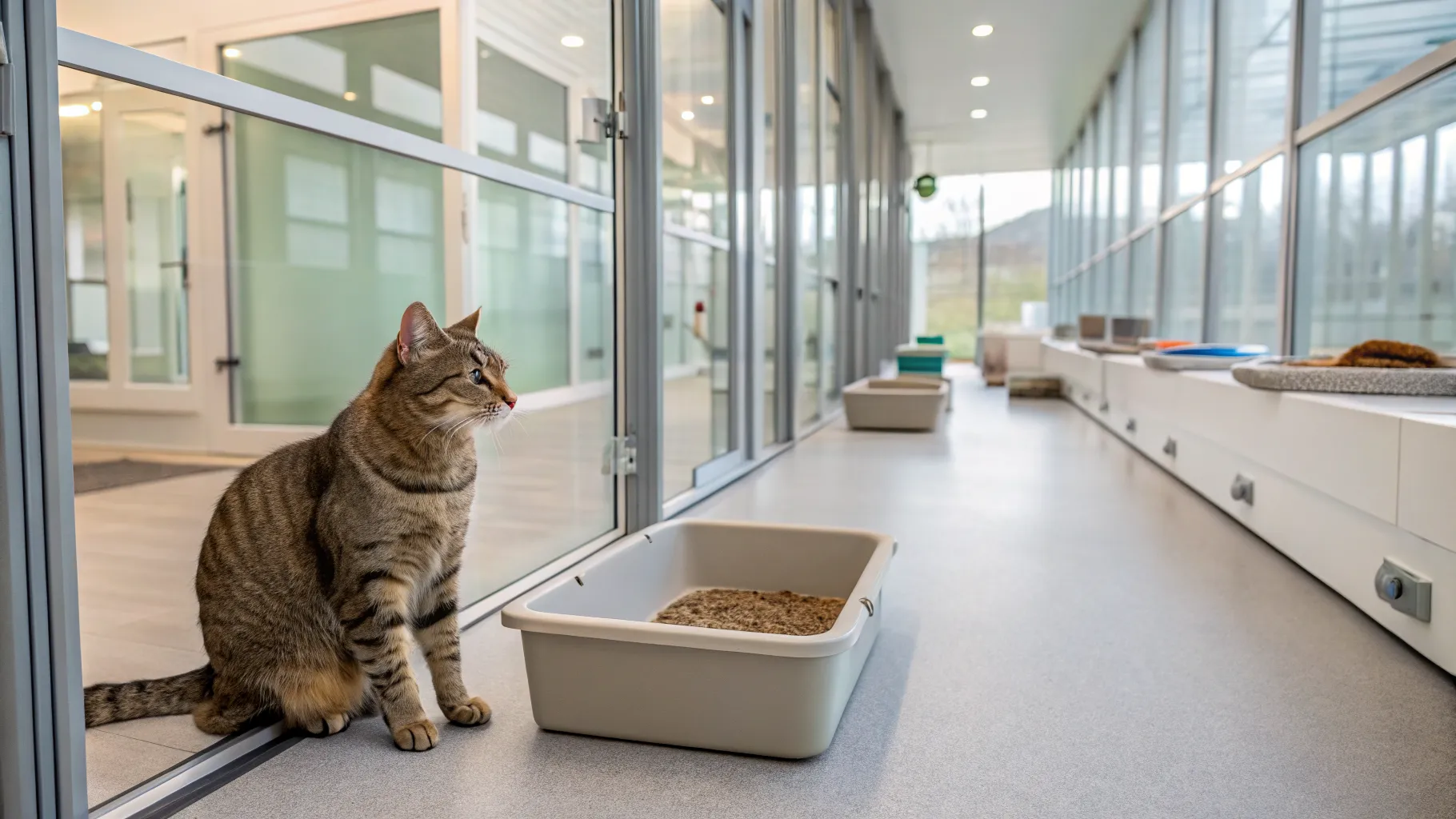
For cats, a single-cat unit needs a sleeping area of at least 0.85 square metres plus an exercise run of at least 1.65 square metres, with at least 60cm of separation between the litter tray, resting place and feeding area inside the unit. You can read the detail in DEFRA’s cat boarding statutory guidance and the matching dog kennel boarding guidance.
Red flags that should end the visit
Some things are not borderline; they are reasons to leave and book elsewhere.
- Refusing to give you a tour, or only showing a “reception” area
- Not asking to see vaccination certificates
- Strong smells of urine, faeces, or heavy cleaning chemicals
- Dirty pens, soiled bedding, or murky water bowls
- Visible overcrowding
- No clear answer on emergency cover or out-of-hours staffing
- Vague or evasive answers about vet arrangements
Cattery-specific points worth knowing
Catteries have their own welfare rules that matter for disease control, and the good ones design around them. Two in particular are worth checking yourself.
- Cats from different households must never share a unit. Boarding is not a place for your cat to make friends; it is a place to stay safe. Cats from the same household can share if they normally live together.
- Sneeze barriers between units. Where units sit side by side, any gap between them must be at least 0.6 metres, or there must be a full barrier to stop airborne disease such as cat flu spreading. A corridor between facing units must be at least 1.2 metres wide; if it is narrower, barriers have to go on the unit fronts. If you see units pressed together with no gap and no barrier, that is a real concern.
Insurance and the vet plan
Two questions people forget to ask. First, confirm the establishment carries public liability insurance and “care, custody and control” cover, which is the cover that applies to animals in their charge. Second, ask for the written emergency plan: which vet they use, what happens if your pet falls ill or is injured, whether they will use your own vet if local, and who authorises treatment and pays up front. A confident operator answers this without hesitation, often with a form for you to sign giving consent and a spending limit.
Cost: what to expect
Prices vary a lot by region and by standard, so always confirm directly with the establishment. Two things hold true nationally: cat boarding is usually a little cheaper per night than dog boarding, and you should expect peak-season supplements over summer and Christmas. Cheaper is not better if it comes from cutting staff or space; weigh the price against the star rating and what you saw on your visit.
A short pre-booking checklist
Before you hand over a deposit, run through this:
- Licence on display, with a star rating and a current expiry date
- Confirmed on the council’s register (checked via gov.uk/find-local-council)
- They asked to see your pet’s vaccination certificate
- You were given a full tour and it smelled and looked clean
- Clear answers on staffing, overnight cover and the vet/emergency plan
- Public liability and care/custody/control insurance confirmed
- For cats: individual units, no shared households, sneeze barriers or gaps in place
If you are still weighing up options, it is worth comparing a kennel against having someone stay at home; our guide on dog boarding vs house sitting sets out the trade-offs. The same instinct that makes you vet a kennel carefully should apply to anyone who handles your pet, whether that is a dog walker or a mobile dog groomer.
Frequently asked questions
Do boarding kennels legally need a licence in the UK, and how do I check it? Yes. In England, kennels and catteries must hold a licence from their local council under the 2018 Regulations, and it must be displayed on the premises. Check it on the wall during your visit, and confirm it on the council’s public register via gov.uk/find-local-council.
What does the star rating on a licence mean? It runs from 1 to 5 and reflects how far the operator exceeds minimum welfare standards plus a council risk assessment. It also sets the licence length: 1 to 2 stars lasts a year, 3 to 4 stars two years, and 5 stars three years. Every licensed place clears the legal minimum; higher stars mean better staff ratios and enrichment.
What vaccinations does my dog need before going into kennels? Canine parvovirus, distemper, infectious canine hepatitis (adenovirus) and leptospirosis, all in date. A primary course must be completed at least two weeks before boarding. Most kennels also require the kennel cough nasal spray, given at least two weeks ahead.
What vaccinations does my cat need for a cattery? Cat flu (feline herpesvirus and calicivirus) and feline infectious enteritis (FIE, also called panleukopenia), with an up-to-date certificate. A cattery that does not ask to see this is one to avoid.
Is the kennel cough vaccine compulsory for boarding? It is not a core legal requirement, but most kennels insist on it. It is a nasal spray, should be given at least two weeks before the stay, and only protects against some of the bugs involved, so a vaccinated dog can still catch a mild case.
What is a sneeze barrier and why does it matter? It is a screen between cat units that stops airborne illness such as cat flu spreading. The rules require either a barrier or a gap of at least 0.6 metres between units. It is one of the clearest signs of a well-designed cattery.
Can two cats share a unit? Only if they come from the same household and normally live together. Cats from different households must never be put in the same unit.
Is putting my pet in kennels cruel? A good, licensed, higher-star establishment with proper space, staffing and enrichment is a safe and often perfectly happy stay. Stress usually comes from poor facilities, not from boarding itself, which is exactly why the licence check and the visit matter.
What questions should I ask before booking? Ask about staff ratios and overnight cover, the vet and emergency plan, what happens if your pet refuses food or seems unwell, insurance cover, and whether you can do a trial day or overnight stay first. A trial run is the best way to see how your pet settles.
What happens if my pet needs a vet while I am away? A reputable establishment has a named vet and a written emergency procedure, and will ask you to sign consent for treatment, often with a spending limit. Confirm this in advance and leave clear contact details and your own vet’s details.
Looking for someone local?
Search your town to find checked groomers, walkers, sitters and pet shops near you, with real owner reviews.
Find local pet services