Your Puppy's First Grooming Appointment: What to Expect
By the Pets Locally team
Updated 2026
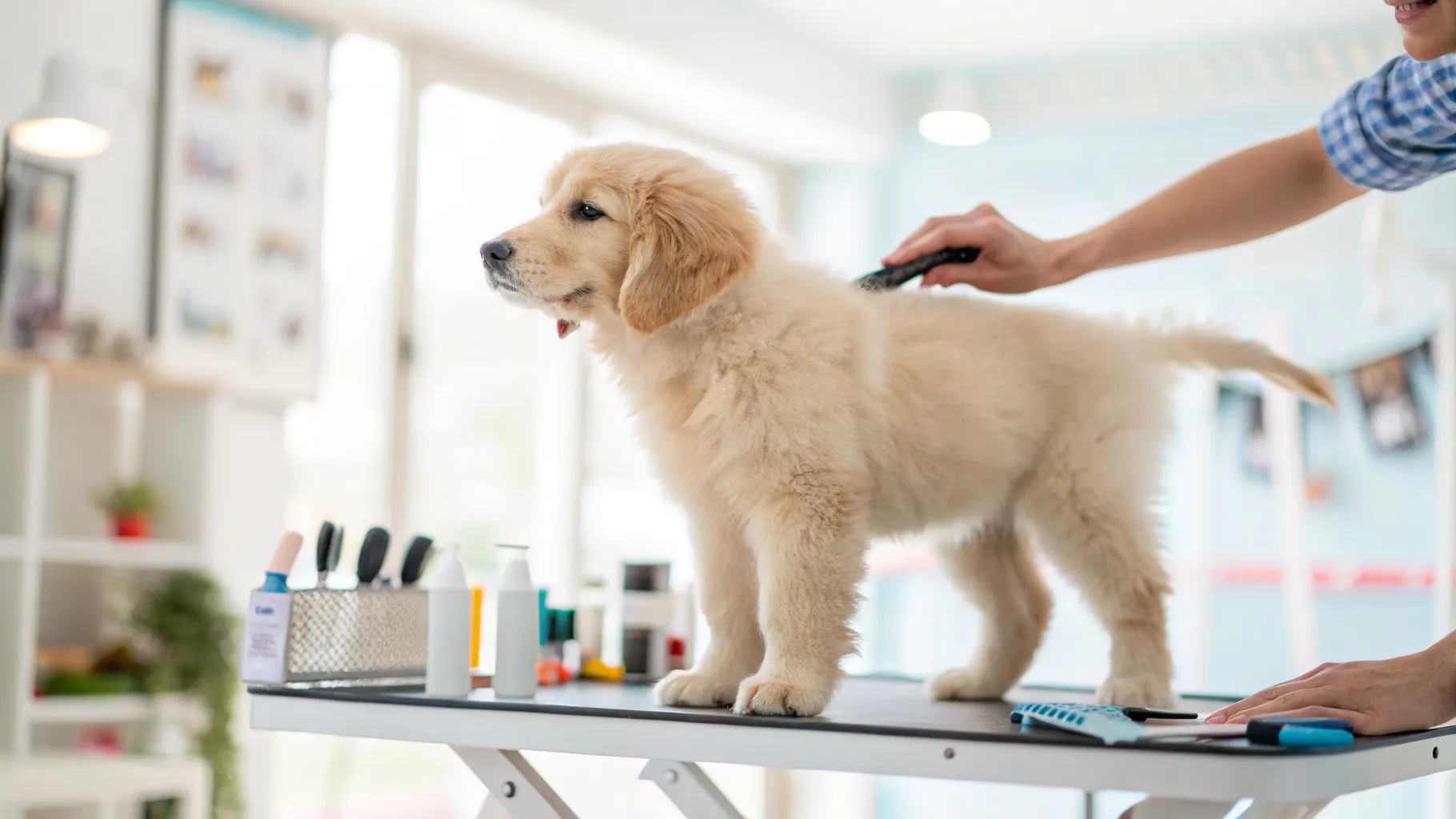
Once your puppy has finished its second course of vaccinations and recovered, you can book a short introductory groom from around 12 to 14 weeks old. That first visit is a taster, not a haircut: a gentle bath, a light brush, a nail trim and lots of treats, kept short so your puppy learns that the groomer is a calm, friendly place. The first proper full groom, with a body clip and a scissor finish, usually waits until the adult coat has come in, often around six months.
This guide separates those two timelines clearly, ties them to the real UK vaccination schedule, and shows you how to vet a groomer in a trade that isn’t licensed.
When can a puppy first be groomed?
The gate is vaccination, not age alone. UK puppies are usually vaccinated at eight and ten weeks, with the second dose given two to four weeks after the first, then a booster at six or twelve months (RSPCA vaccination guidance). Most groomers will not take a puppy until that second vaccination is complete, because an unvaccinated puppy shouldn’t be mixing in a salon environment.
After a jab, give your puppy time to recover before the appointment. The common advice is to leave at least 48 hours, and ideally about a week, because a puppy can be sore or a bit off-colour, and a first grooming experience needs to feel positive, not stressful. Put together, that puts the first introductory visit at roughly 12 to 14 weeks for most puppies.
Introductory groom vs full groom: two different things
Owners get caught out by pages that quote a single “first groom age” of six months. There are really two milestones, and they happen months apart.
| Introductory / puppy groom | First full groom | |
|---|---|---|
| Typical timing | From ~12 to 14 weeks, after the 2nd vaccination | Once the adult coat is in, commonly ~6 months; some larger or thicker-coated breeds 8 to 12 months |
| What it includes | Gentle bath, light brush, nail trim, getting used to the table and the dryer noise, handling and treats | Bath, full body clip and/or scissor finish, styling to the breed or owner’s preference |
| Goal | Confidence and a calm association, kept short | A proper tidy and a coat reset on the grown-in adult coat |
| Typical UK cost | Around £27.50 on average | Around £50 for a medium dog; roughly £25 to £100+ by size, coat and area |
Larger or thick double-coated breeds take longest to grow their adult coat, sometimes up to a year, so don’t rush the first full clip. A puppy taken straight for a full haircut before it’s used to the equipment can find the whole thing frightening, and that fear tends to stick.
What actually happens at the first appointment
A good first session is built around handling rather than results. Expect the groomer to:
- weigh and settle your puppy, and let it sniff around the table
- run a light brush through the coat and check for any tangles
- give a gentle bath and a short blast of the dryer on a low, cool setting so the noise stops being scary
- trim the nails, and handle the paws, ears and face
- finish with plenty of treats and praise, and keep the whole thing short
A puppy taster usually runs shorter than an adult groom precisely because the aim is to stop before your puppy gets tired or overwhelmed. If your puppy has a wobble, a good groomer slows down or pauses rather than pushing through.
Two add-ons you should question
Some salons still offer anal-gland expression and ear-hair plucking as routine extras. Veterinary thinking has moved on. Current guidance is that neither should be done routinely unless there is a clinical reason, because expressing anal glands or plucking ear hair unnecessarily can cause pain, trauma or new problems. The Royal College of Veterinary Surgeons is also clear that a groomer expressing anal glands without a vet delegating it case by case risks straying into veterinary diagnosis. If a groomer lists these as standard, it’s fair to ask why, and to decline unless your vet has flagged a genuine issue.
How to prepare your puppy
The work you do at home in the weeks before the appointment matters more than anything that happens on the day:
- Burn off energy first. Walk your puppy before the appointment so it’s calmer, and give it a chance to toilet.
- Handle the awkward bits daily. Touch the paws, ears and face a little every day so being held still feels normal.
- Introduce the sounds and sensations. Brush gently at home, and run a hairdryer on a low, cool setting nearby so the dryer isn’t a shock.
- Brush out loose tangles beforehand. Deal with small knots yourself rather than leaving a matted coat for the groomer to fight through.
- Book a meet-and-greet first. A short visit to see the space and meet the person calms both of you and lets you ask questions.
Coat type changes everything
Coat type drives how often your puppy needs grooming and how much it costs. Curly, non-shedding “poodle cross” coats (cockapoos, cavapoos, cockerpoos) and dense double coats need the most upkeep, and matting is the main risk.
Here is the honest part that many pages skip: if a curly coat is left until it’s heavily matted, the kind thing is often to clip it short, sometimes very short. De-matting a badly tangled coat is painful, it pulls at the skin and it can nick the skin, so a responsible groomer will choose a “shave down” over hours of yanking. That outcome is preventable with regular brushing at home and grooms booked often enough, usually every four to eight weeks for these coats, rather than waiting for a problem. If you own a poodle cross, plan for that rhythm from the start.
How to check a groomer in an unregulated trade
Dog grooming is not a licensed or regulated trade in the UK, so anyone can call themselves a groomer. That makes the few real, checkable credentials worth knowing.
- City & Guilds qualifications (number 7863). Look for the Level 2 Certificate for Dog Grooming Assistants or the Level 3 Diploma in Dog Grooming. The Level 3 Diploma assesses a groomer on dogs of different coat types and grooming requirements, covering health checks, handling, technique and finishing, so it’s a meaningful signal.
- BDGA / PIF membership. The British Dog Groomers’ Association is the grooming division of the Pet Industry Federation. A groomer displaying BDGA membership is choosing to align with a professional body, which is a reasonable badge to look for.
- Insurance and a willingness to answer questions. A good groomer is happy to talk through their training, their handling approach and what they’ll do if your puppy struggles.
If you want a structured way to assess candidates, our guide on how to choose a dog groomer walks through what to look for, and if you’re leaning towards a van that comes to you, the questions to ask a mobile dog groomer covers the points specific to that setup. Either way, use a meet-and-greet to ask them in person.
Salon or mobile for the first groom?
Both can work well for a puppy. A salon exposes your puppy to other dogs, noises and a busier environment, which can be good early socialisation if it’s handled gently. A mobile groomer comes to your driveway, which means a quieter, one-to-one setting with no waiting room and no other dogs, and that calmer environment suits a nervous puppy. The deciding factor is the individual groomer’s patience with puppies, not the format. Whichever you pick, the first session should still be a short, positive taster. If you’re also lining up other care while your puppy grows, our notes on choosing a boarding kennel or cattery use the same vetting mindset.
Frequently asked questions
At what age can my puppy have its first groom? Usually around 12 to 14 weeks, once the second course of vaccinations is complete and your puppy has had time to recover. That first visit is a short introductory session, not a full haircut.
Can a puppy be groomed before its second vaccination? Generally no. Most groomers will not see a puppy until the second vaccination is done, because an unvaccinated puppy shouldn’t be mixing in a salon environment. Wait until the course is complete, then leave time to recover.
How long after a vaccination should I wait before grooming? Leave at least 48 hours, and ideally about a week. A puppy can be sore or off-colour after a jab, and a first grooming experience should feel calm and positive rather than stressful.
How much does a puppy groom cost in the UK? An introductory puppy groom averages around £27.50, which is cheaper than a full adult groom. A full groom for a medium dog averages roughly £50, with a typical range of about £25 to £100 or more depending on size, coat type and where you live.
When does my puppy get its first full haircut? Once the adult coat has come in, commonly around six months. For some larger or thicker-coated breeds it can be 8 to 12 months, so it’s worth waiting rather than clipping a coat that hasn’t finished changing.
Should a groomer express my puppy’s anal glands or pluck its ears? Not as a routine. Veterinary guidance, including from the Royal College of Veterinary Surgeons, advises against expressing anal glands or plucking ear hair unless there’s a clinical reason, because doing so unnecessarily can cause pain or new problems. Question it if a salon offers either as standard, and only proceed if your vet has flagged a genuine issue.
Looking for someone local?
Search your town to find checked groomers, walkers, sitters and pet shops near you, with real owner reviews.
Find local pet services