Red Flags: Signs of a Bad Boarding Kennel
By the Pets Locally team
Updated 2026
Most articles on bad boarding kennel signs come from the United States and lean on vague advice like “trust your gut” or “if it smells off, leave”. That is fine as far as it goes, but it misses the one tool a UK owner actually has on their side: in England, every commercial kennel must hold a council licence with a public star rating, and the law sets out exactly how much space, what temperature, what staff numbers and what vaccinations a boarded dog is entitled to. So the most reliable way to spot a bad kennel is not a feeling. It is to measure what you see against those legal benchmarks. This guide gives you the benchmarks and the warning signs, scoped to England.
The master red flag: no licence
Boarding dogs commercially without a council licence is a criminal offence in England, under the Animal Welfare (Licensing of Activities Involving Animals) (England) Regulations 2018. Operating without one, or breaching the conditions of one, is an offence under the Animal Welfare Act 2006 and can mean an unlimited fine and up to six months in prison.
For you as an owner, this turns into two quick checks:
- A copy of the licence must be displayed clearly and prominently on the premises. If you visit and cannot find it on a wall or in reception, ask. If they cannot produce it, walk away.
- The business name and licence number must appear on any website it uses. No licence number on the site is a warning sign before you have even phoned.
You do not have to take the wall certificate on trust either. Find the relevant council via gov.uk/find-local-council and look for its public register of licensed animal boarding establishments. Most councils publish this online; others release it on request, by phone or email. If a kennel is licensed, it will be on that list with its star rating and expiry date. If it is not on the list and not displaying a licence, that is the strongest red flag there is, because it usually means the place is operating illegally.
A note on the rest of the UK: the 2018 Regulations and the star-rating system are specific to England. Scotland, Wales and Northern Ireland run their own licensing schemes, so if you are outside England, check your nation’s equivalent register rather than assuming the same rules apply.
What the star rating tells you
Every licensed kennel carries a rating from 1 to 5 stars. It reflects two things: the welfare standard the place actually achieves, and a risk rating based on its compliance history. As a rough guide, 1 star points to minor, usually administrative failings; 2 to 3 stars means the place meets the standard; 4 to 5 stars means it meets higher standards. Better-rated businesses earn longer licences, so a 5-star kennel holds a three-year licence rather than a one-year one.
A 1-star rating is not an automatic disaster, but it is a signal to ask what the failings were and whether they have been fixed. A kennel that refuses to discuss its rating at all is a different matter, and that evasiveness is itself a red flag.
The legal welfare standards, so you can measure what you see
Here are the figures from the government’s dog kennel boarding statutory guidance. Consumer guides rarely quote them, which is a shame, because they turn a vague unease into something you can actually check.
| What | Minimum standard | Higher standard |
|---|---|---|
| Sleeping area | At least twice the area the dog needs to lie flat; new builds at least 1.9 m² | At least 2.85 m² |
| Temperature | Above 10°C and below 26°C in part of the sleeping area, with dogs monitored for heat or cold stress | Same, with closer monitoring |
| Staff ratio | One staff member per 25 dogs or fewer | At least one full-time member per 15 dogs |
| Exercise | At least one walk a day or access to secure open space; no more than 6 dogs walked per person | Two exercise periods a day, each at least 20 minutes |
| Resources | Each dog has its own resources (beds, bowls, toys), in multiples equal to or above the number of dogs in a unit | As minimum |
The guidance also requires that a dog can stand at full height, lie fully stretched out, wag its tail, turn around and walk without touching the walls or another dog, and that it gets exposure to natural light for part of the day. If you watch a dog in a pen that cannot turn without bumping the sides, or a windowless block with the lights doing all the work, the place is failing the standard you are paying it to meet.
Vaccinations: a kennel that does not ask is breaking the law
Licensed kennels are legally required to make sure boarded dogs are vaccinated, and to refuse a dog that is not. So if a kennel does not ask to see your dog’s vaccination record, that is not a relaxed, friendly attitude. It is a legal failure, and it tells you the dog in the next pen was probably not checked either, which puts your dog at risk.
The required core vaccinations for dogs are:
- Canine parvovirus
- Canine distemper
- Infectious canine hepatitis (canine adenovirus)
- Leptospirosis
A primary course must be completed at least two weeks before boarding so immunity has time to build. Kennel cough (caused largely by Bordetella and canine parainfluenza) is a separate case: the vaccine is at each establishment’s discretion rather than legally mandated, but a kennel that requires it is showing a higher standard, not being awkward. It is given by nose or mouth, usually 14 to 21 days before arrival, and the dog is not fully protected until roughly 72 hours after the dose, so some kennels ask for a longer window. The Royal Veterinary College has a clear explainer on the kennel cough vaccine if you want the detail to take to your own vet.
The red-flag checklist
Pull the above together and a short, concrete list of warning signs falls out. Any one of these is a reason to look harder; several together is a reason to book elsewhere.
- No licence displayed, no licence number on the website, or not on the council register. This is the top red flag and may mean the kennel is illegal.
- Won’t let you tour, or is reluctant to show the actual sleeping and run areas before you book. A confident operator shows you everything.
- Doesn’t ask for vaccination records. A legal failure and a health risk in one.
- Vague or no answer on the vet and emergency plan, medication handling, overnight supervision or fire procedure.
- Overwhelmed, distracted staff who do not know the dogs by name, or numbers that clearly exceed roughly 25 dogs per staff member.
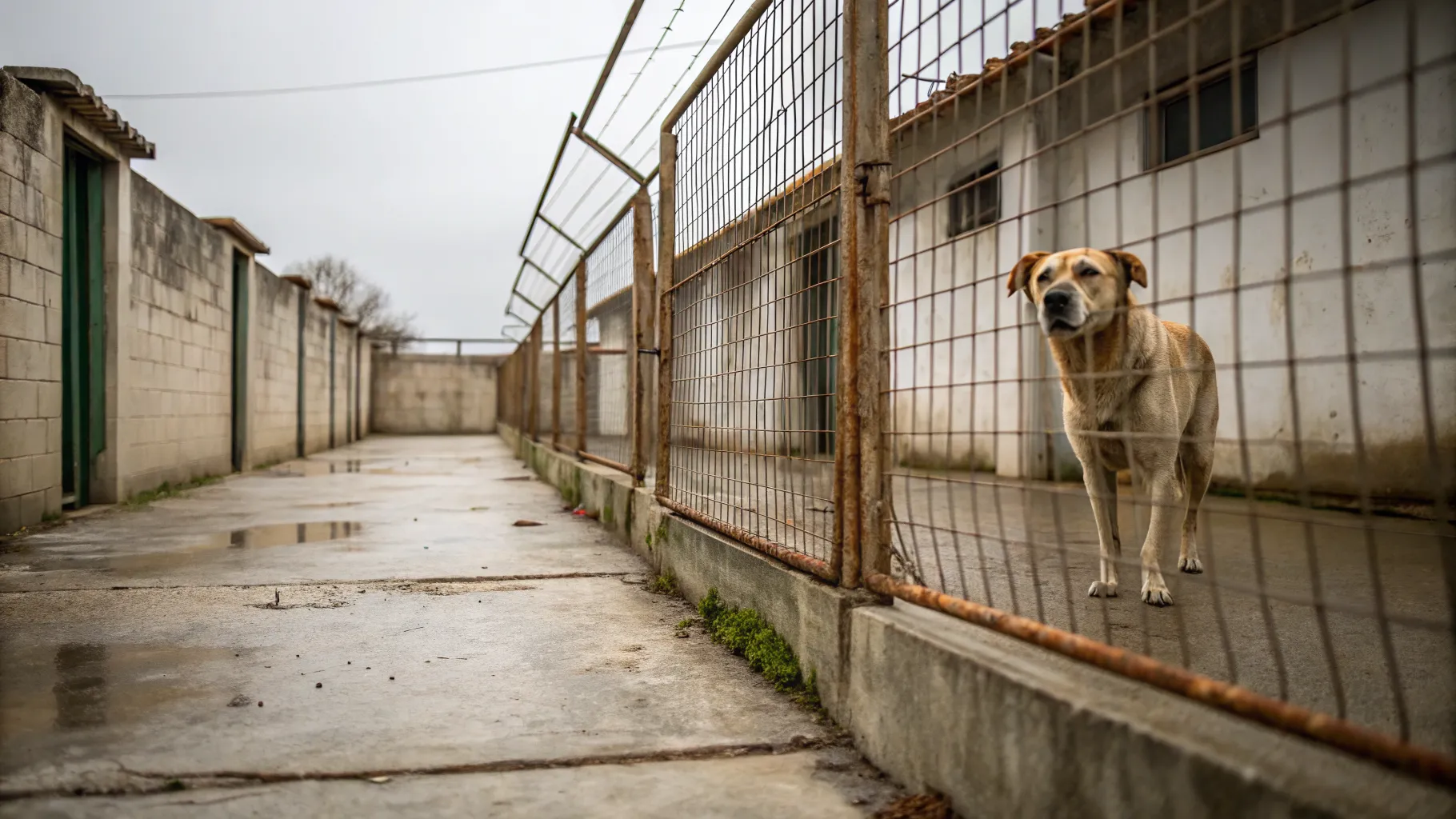
- A persistent ammonia stench, dirty runs and no visible cleaning routine. A faint wet-dog smell is normal; a reek of urine is not.
- Cramped units where dogs cannot turn or stretch, no natural light, and no daily exercise or secure outdoor space.
- No system to keep each dog’s resources separate, or unfamiliar dogs thrown together for unstructured group play.
- Won’t accommodate your dog’s own food or has no plan for keeping its diet consistent.
- A 1-star rating they will not explain, or any refusal to discuss the rating at all.
Questions that flush out a bad kennel
You can learn most of this with a handful of direct questions before you even visit:
- Can I see your licence and star rating, and what is your licence number?
- What is your vaccination policy, and do you check records on arrival?
- How many staff are on site, and is anyone here overnight?
- Which vet do you use, and what happens if my dog falls ill or is injured?
- Can I bring my dog’s own food, and how do you handle a dog that goes off its meals?
- Can I have a full tour, including where the dogs sleep?
A good kennel answers all six without hesitation. Stalling, defensiveness or “we don’t really do tours” tells you what you need to know.
My dog came home stressed: bad kennel or normal?
This worries owners more than almost anything, so it is worth separating the everyday from the genuine concern. Mild tiredness, a slightly loose stool for a day or two, or being over-excited and clingy are common and usually pass quickly. They tend to come from a change of routine, the stress of being somewhere new, or simply eating different food, which is exactly why bringing your dog’s own food matters.
What is not in the “normal” bracket and warrants a vet visit: a persistent honking cough, ongoing vomiting or diarrhoea, lethargy combined with eye discharge, a flat refusal to eat, or any injury. If your dog comes back genuinely unwell and you also saw poor conditions, raise it with the council that issued the licence. Complaints feed into the risk rating that sets a kennel’s stars, so reporting a bad experience is not just venting; it is part of how the system works.
Where a kennel may not be the right call at all
A bad kennel is bad, but even a good kennel is not the right setting for every dog. A nervous, recently rehomed or elderly dog often does better staying in its own home with a sitter, or in the smaller, domestic setting of a licensed home boarder. If your dog falls into that group, it is worth weighing the options before you commit to kennels at all; our guide on dog boarding vs house sitting lays out the trade-offs on cost, stress and safety.
If you have decided a kennel is right and just want to pick a good one rather than spot a bad one, the companion piece on what to look for in a good boarding kennel or cattery walks through the licence check, star ratings and visit in full. And the same instinct that makes you scrutinise a kennel should apply to anyone who handles your pet, including a dog walker you have never met.
Frequently asked questions
How do I check if a boarding kennel is licensed and see its star rating? Look for the licence displayed on the premises and the licence number on the kennel’s website. To confirm it independently, find the local council via gov.uk/find-local-council and search its public register of licensed animal boarding establishments, which lists the star rating and expiry date.
Is it legal to board dogs without a licence in the UK? In England, no. Commercial dog boarding without a council licence under the 2018 Regulations is a criminal offence under the Animal Welfare Act 2006, punishable by an unlimited fine and up to six months in prison. An unlicensed kennel is breaking the law and is the single biggest red flag.
What vaccinations does my dog need for kennels, and how far in advance? Core required jabs are canine parvovirus, distemper, infectious canine hepatitis (adenovirus) and leptospirosis, with any primary course completed at least two weeks before the stay. Kennel cough is optional but often required, given roughly 14 to 21 days ahead.
My dog came back stressed and off its food. Is that a sign of a bad kennel? Often not. Mild tiredness, a day or two of loose stool and being clingy are common reactions to a new place and changed routine. Be concerned, and see a vet, if you notice a persistent cough, ongoing vomiting or diarrhoea, lethargy with eye discharge or refusal to eat.
Should I worry if a kennel won’t let me tour where my dog sleeps? Yes. Refusing a tour of the actual sleeping and run areas is a recognised red flag. A reputable kennel is happy to show you everything, because the conditions are the selling point. Reluctance usually means there is something they would rather you did not see.
How much space and what temperature should a kennel provide? Under the statutory guidance, a new-build sleeping area must be at least 1.9 m² (2.85 m² for the higher standard), and part of the sleeping area must stay above 10°C and below 26°C. The dog must be able to stand, stretch out, turn around and wag its tail without touching the walls or another dog.
Looking for someone local?
Search your town to find checked groomers, walkers, sitters and pet shops near you, with real owner reviews.
Find local pet services